ACSMI Multi-Domain Cybersecurity Training: Accredited Cybersecurity Course & Certification Program

ACSMI’s Accredited Multi-Domain Cybersecurity Certification

Industry-Aligned. Employer-Trusted. Globally Respected.

Cybersecurity training across all domains is no longer optional, it’s critical for entry and mid-level role progression. This is why ACSMI’s Advanced Multi-Domain Cybersecurity Certification Program is purpose-built for individuals who want applicable knowledge, real skills, and real career outcomes in today’s high-stakes cyber landscape.

Whether you are a college graduate, IT professional, career switcher, or security leader, ACSMI delivers one of the most comprehensive, employer-aligned cybersecurity education programs in the world, designed to prepare you for real-world threats, enterprise environments, and top-tier certifications badges while also teaching you all major domains within cybersecurity so you can progress in your career.


Accredited Cybersecurity Training Curriculum Led by Industry Experts

Accredited, Industry-Aligned Cybersecurity Course Curriculum

ACSMI’s cybersecurity curriculum is fully accredited and meticulously aligned with global industry standards and employer expectations. Designed across multiple cybersecurity domains, the program integrates technical defense, governance, risk, compliance, and real-world threat response. Every module is continuously updated to reflect the evolving cyber threat landscape, ensuring learners gain relevant, job-ready skills trusted by employers and institutions worldwide.


Expert Instructors with Real-World Cybersecurity and Leading Cyber Security Training Experience

Learn directly from seasoned cybersecurity professionals with extensive experience across enterprise, government, and high-risk environments. ACSMI instructors bring real-world insight into every lesson, bridging theory with practical application. From live instruction to hands-on labs, learners benefit from mentorship grounded in real incidents, real tools, and real operational environments.

Multi-Domain Cybersecurity Certification Driven Training Built for Career Outcomes

ACSMI’s curriculum is strategically designed to prepare learners for industry-recognized cybersecurity certifications while building deeper professional competence beyond exams. Training supports pathways toward credentials while also emphasizing applied mastery, analytical thinking, and enterprise-ready performance, giving graduates a competitive edge in today’s cybersecurity job market.

Why ACSMI Cybersecurity Training Is Different

Most cybersecurity programs teach tools. ACSMI builds cybersecurity professionals. Our programs go beyond theory, integrating technical mastery, strategic thinking, governance, risk, compliance, and leadership across every major cybersecurity domain. Program Highlights 4–16 week immersive bootcamps or flexible self-paced tracks 300+ interactive learning modules Live expert-led webinars Hands-on cyber labs & simulations Enterprise-grade tools & platforms Certification-aligned instruction Career readiness & employer relevance This is cybersecurity education designed for today’s threat environment and tomorrow’s leadership roles.

Comprehensive Cybersecurity Bootcamp Program with Multi-Domain Coverage

Advanced Cybersecurity Bootcamp (Multi-Domain) Our flagship cybersecurity bootcamp delivers an immersive, end-to-end learning experience covering all critical domains of modern cybersecurity, including: Network & Cloud Security Threat Detection & Incident Response Ethical Hacking & Penetration Testing Governance, Risk & Compliance (GRC) Security Operations (SOC) Cyber Law, Policy & Ethics Enterprise Security Architecture and several other domains that may be the key to landing your next role You’ll train using real tools, real scenarios, and real attack simulations, all guided with 1-1 mentorship so you graduate ready to operate in live environments. ✔ Designed for career acceleration ✔ Gain interview confidence for employers & institutions ✔ Built for long-term advancement

Flexible Cybersecurity Course Options

We recognize that high-performing professionals need flexibility. Choose Your Path: Fast-Track Bootcamp (4–16 weeks) Self-Paced Certification Track Hybrid Live + On-Demand Learning Every ACSMI cybersecurity course is: Industry-aligned Continuously updated Mapped to real job roles Built for measurable skill acquisition You don’t just complete a course, you build career-ready competence. Expert-Led Instruction & Certification Preparation Learn directly from seasoned cybersecurity professionals with enterprise and government experience. Our instructors guide you through: Hands-on training with tools like Splunk, Metasploit, SIEM platforms, and cloud security frameworks Practical implementation of security controls and response strategies Strategic preparation for industry-recognized certifications You’ll also gain access to a professional cybersecurity community, networking opportunities, and ongoing learning support.

ACSMI Cybersecurity Syllabus - Explore Our World-Class MultiDomain Cybersecurity Training for Future Leaders

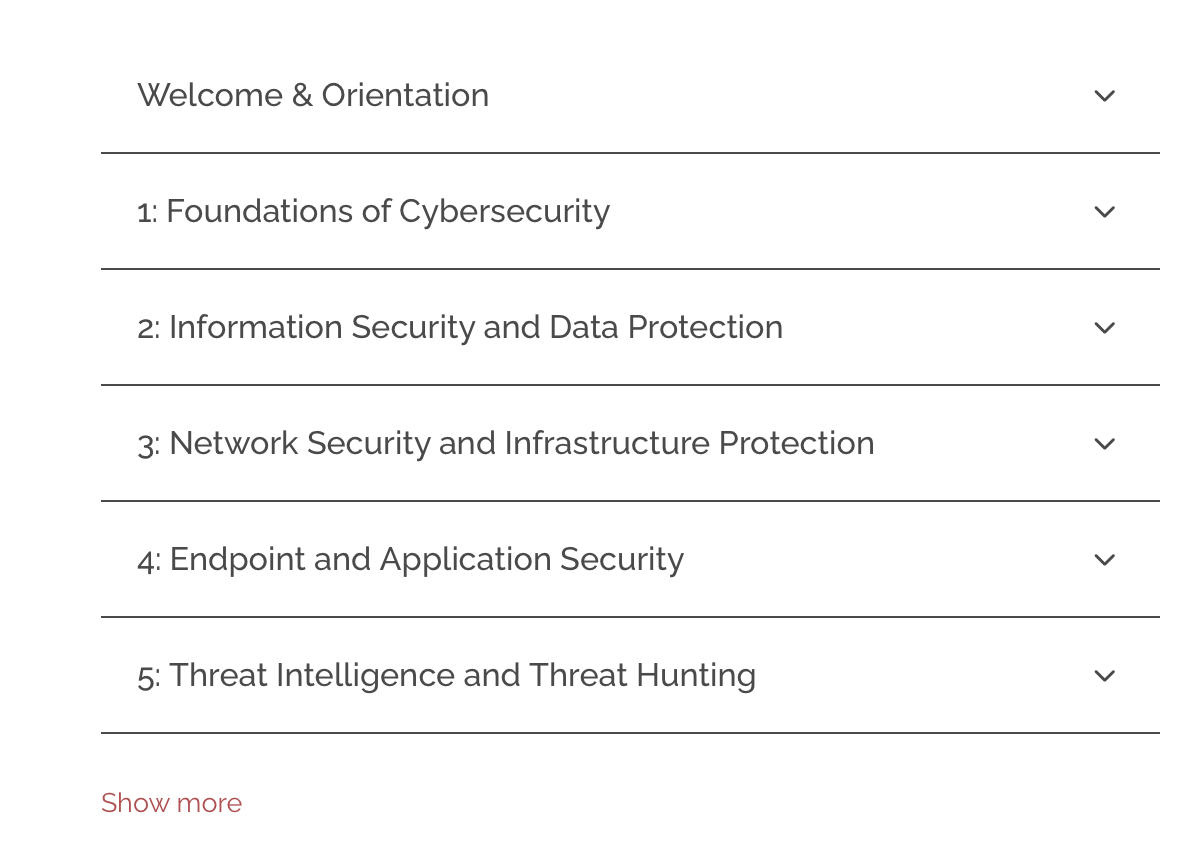
Advanced Cybersecurity & Management Certification (ACSMC) Explore our cutting-edge cybersecurity certification syllabus for 2025 designed to interactive mastery in all cybersecurity domains. Welcome & Orientation ACSMI Course Overview What to Expect Course Syllabus and Schedule Format & Overview Course Policies & Enrollment Agreement ACSMI Workbook Capstone Project Instructions 1: Foundations of Cybersecurity Chapter 1 Overview / To-Do FREE PREVIEW Introduction to Cybersecurity FREE PREVIEW History of Cybersecurity FREE PREVIEW Cybersecurity Terminology FREE PREVIEW Cyber Threat Landscape Emerging Threats and Technologies Cybersecurity Frameworks Cybersecurity Policies and Governance Risk Management in Cybersecurity FREE PREVIEW Legal and Ethical Issues in Cybersecurity Cybersecurity Standards and Compliance Cybersecurity in Government Cybersecurity in Finance Cybersecurity in Healthcare Cybersecurity in Retail Cybersecurity in Education Cybersecurity in Small and Medium Enterprises (SMEs) Practical Application for Foundations of Cybersecurity 2: Information Security and Data Protection Chapter 2 Overview / To-Do Information Security Management Data Protection and Privacy Security Metrics and Reporting Access Control Mechanisms Identity and Access Management (IAM) Authentication and Authorization Cryptography Basics Public Key Infrastructure (PKI) Advanced Cryptography Secure Development for IoT Devices Cybersecurity in Insurance Cybersecurity in Real Estate Transactions Cybersecurity in Real Estate Supply Chain Management Cybersecurity in Logistics and Transportation Practical Application for Information Security and Data Protection 3: Network Security and Infrastructure Protection Chapter 3 Overview / To-Do Network Security Fundamentals Cybersecurity Architecture Firewalls and Network Security Devices Intrusion Detection and Prevention Systems (IDPS) Virtual Private Networks (VPNs) Wireless Security Zero Trust Architecture Network Traffic Analysis Network Segmentation and Isolation Advanced Firewall Configurations IPv6 Security Considerations Wireless Intrusion Prevention Systems (WIPS) Advanced VPN Configurations Cybersecurity in 5G Networks Cybersecurity in Telecommunications 4: Endpoint and Application Security Chapter 4 Overview / To-Do Endpoint Security Application Security Web Security Mobile Security Cloud Security IoT Security Industrial Control Systems Security Cybersecurity in Wearable Technology Cybersecurity in Smart Appliances Cybersecurity in Smart Buildings Cybersecurity in Smart Retail Cybersecurity in Smart Transportation Cybersecurity in Smart Cities Cybersecurity in Smart Nations 5: Threat Intelligence and Threat Hunting Chapter 5 Overview / To-Do Threat Intelligence and Analysis Advanced Threat Detection Advanced Persistent Threats (APTs) Cybersecurity in Machine Learning Red Teaming and Blue Teaming Purple Teaming Cyber Threat Intelligence Platforms Advanced Threat Hunting Cybersecurity in Augmented Reality (AR) and Virtual Reality (VR) Cybersecurity in Virtual Reality (VR) Cybersecurity in Mixed Reality (MR) Cybersecurity in Extended Reality (XR) Cybersecurity in Robotics 6: Incident Response and Digital Forensics Chapter 6 Overview / To-Do Incident Response and Management Security Operations Center (SOC) Management Digital Forensics Memory Forensics Network Forensics Mobile Device Forensics Email Forensics Cloud Forensics Cybersecurity in Healthcare Research Cybersecurity in Pharmaceutical Industry Cybersecurity in Medical Devices Cybersecurity in Telemedicine Cybersecurity in Health Information Systems Cybersecurity in Genomics Cybersecurity in Personalized Medicine Cybersecurity in Clinical Trials 7: Malware Analysis and Reverse Engineering Chapter 7 Overview / To-Do Malware Analysis Advanced Malware Analysis Reverse Engineering Advanced Malware Reverse Engineering Cybersecurity in Biotechnology Cybersecurity in Nanotechnology Cybersecurity in Quantum Computing Cybersecurity in Blockchain Applications Cybersecurity in Cryptocurrency Cybersecurity in Smart Contracts Cybersecurity in E-commerce Cybersecurity in Digital Payments 8: Ethical Hacking and Penetration Testing Chapter 8 Overview / To-Do Penetration Testing Web Application Hacking Hacking Mobile Applications Wireless Network Penetration Testing IoT Device Hacking Bug Bounty Programs Comprehensive Reconnaissance Techniques Password Cracking Tools Network Mapping and Discovery Web Vulnerability Scanning Physical Penetration Testing 9: Cloud Security and Virtual Environments Chapter 9 Overview / To-Do Cloud Security Architecture Securing Cloud Infrastructure Identity and Access Management in Cloud Cloud Security Automation Cloud File Sharing Security Cloud Penetration Testing Business Continuity in the Cloud Cybersecurity in Environmental Monitoring Serverless Security Container Security Fundamentals Cloud Compliance 10: Cybersecurity in Industry Sectors Chapter 10 Overview / To-Do Cybersecurity in Manufacturing Cybersecurity in Energy and Utilities Cybersecurity in Transportation Cybersecurity in Defense and Military Cybersecurity in Supply Chain Management Cybersecurity in Maritime Industry Cybersecurity in Aviation Cybersecurity in Critical Infrastructure 11: Business Continuity and Disaster Recovery Chapter 11 Overview / To-Do Business Continuity and Disaster Recovery Advanced Business Continuity Planning Advanced Disaster Recovery Planning Cybersecurity in Smart Grids Cybersecurity in Mergers and Acquisitions Cybersecurity in Digital Twins 12: Social Engineering and Human Factors Chapter 12 Overview / To-Do Advanced Social Engineering Defense Cybersecurity Awareness and Training Ethical Considerations in Cybersecurity Cybersecurity in Law Enforcement Cybersecurity in Emergency Services Cybersecurity in Public Safety Cybersecurity in Museums and Galleries Cybersecurity in Libraries and Archives Cybersecurity in Language Services Cybersecurity in Travel and Tourism Cybersecurity in Hospitality Management Cybersecurity in Media and Entertainment Cybersecurity in Music Industry 13: Security Operations and Automation Chapter 13 Overview / To-Do Security Information and Event Management (SIEM) Security Orchestration, Automation, and Response (SOAR) Advanced SIEM Solutions Endpoint Detection and Response (EDR) Tools Intrusion Detection and Prevention Systems (IDPS) Tuning Cybersecurity Metrics and KPIs Cybersecurity Program Management Cybersecurity Budgeting and Resource Allocation Cybersecurity Vendor Management Supply Chain Security Cybersecurity in Smart Healthcare 14: Threat Hunting and Proactive Defense Chapter 14 Overview / To-Do Vulnerability Management Zero Trust Network Access (ZTNA) Red Team vs Blue Team Scenarios Purple Team Operations Cybersecurity in Space Communication Cybersecurity in Autonomous Systems Cybersecurity in Unmanned Aerial Vehicles (UAVs) Cybersecurity in Robotics Process Automation (RPA) 15: Advanced Network and Infrastructure Security Chapter 15 Overview / To-Do Advanced Network Security Advanced VPN Management Intrusion Detection and Prevention (IDPS) Techniques Advanced Firewall Management Networking for Cloud Environments Network Forensics Securing Wireless Networks Mid-Point Progress Check: Final Exam & Capstone Readiness Check Point! 16: Cybersecurity Certifications and Career Paths Chapter 16 Overview / To-Do Cybersecurity Certifications Overview Certified Information Systems Security Professional (CISSP) Certified Ethical Hacker (CEH) CompTIA Security+ GIAC Security Essentials (GSEC) Offensive Security Certified Professional (OSCP) Certified Information Security Manager (CISM) Certified Information Systems Auditor (CISA) CompTIA Cybersecurity Analyst (CySA+) Certified Cloud Security Professional (CCSP) GIAC Certified Forensic Analyst (GCFA) GIAC Certified Incident Handler (GCIH) GIAC Certified Incident Handler (GCIH) GIAC Certified Incident Handler (GCIH) GIAC Penetration Tester (GPEN) GIAC Certified Web Application Defender (GWEB) 17: Practical Cybersecurity Skills and Training Chapter 17 Overview / To-Do CTF Challenges Practical Red-Team Certifications (CRTO) End-to-End Penetration Test Incident Response Planning and Execution Advanced SIEM Management Practical Machine Learning for Cybersecurity GIAC Certified Web Application Defender (GWEB) Quantum Computing and Cryptography 18: Capstone Project and Final Review Chapter 18 Overview / To-Do Designing a Comprehensive Defense Strategy Breach Simulation and Mitigation Building a Cybersecurity Portfolio Penetration Testing Frameworks IoT Security Protocols 19: Cybersecurity in Different Sectors Chapter 19 Overview / To-Do Cybersecurity in Agriculture Cybersecurity in Non-Profit Organizations Cybersecurity in Startups Cybersecurity in Large Enterprises Cybersecurity in Real Estate Cybersecurity in Fintech Cybersecurity in Digital Payments Cybersecurity in Space Exploration Cybersecurity in Intelligence Agencies Cybersecurity in Biotechnology Research Cybersecurity in Agricultural Technology Cybersecurity in Food Supply Chain Cybersecurity in Water Management Cybersecurity in Waste Management Cybersecurity in Renewable Energy Cybersecurity in Nuclear Energy 20: Cybersecurity Technologies and Advanced Techniques Chapter 20 Overview / To-Do Blockchain Security Artificial Intelligence in Cybersecurity Machine Learning for Cybersecurity Advanced Penetration Testing Advanced Incident Response Advanced Digital Forensics IoT Forensics Cybersecurity in Autonomous Vehicles Cybersecurity in Edge Computing Cybersecurity in Consumer Goods Cybersecurity in Packaging Industry 21: Certifications and Professional Development Chapter 21 Overview / To-Do CompTIA Advanced Security Practitioner (CASP+) GIAC Certified Intrusion Analyst (GCIA) GIAC Certified Enterprise Defender (GCED) GIAC Certified Windows Security Administrator (GCWN) GIAC Certified UNIX Security Administrator (GCUX) GIAC Certified Incident Response Handler (GCIH) GIAC Certified Project Manager (GCPM) GIAC Certified Penetration Tester (GPEN) GIAC Certified Penetration Tester (GPEN) GIAC Certified Forensic Examiner (GCFE) GIAC Certified Web Application Defender (GWEB) GIAC Certified Web Application Defender (GWEB) 22: Cybersecurity in Industries and Critical Infrastructure Chapter 22 Overview / To-Do Cybersecurity in Oil and Gas Cybersecurity in Mining Cybersecurity in Chemical Industry Cybersecurity in Manufacturing 4.0 Cybersecurity in Textile Industry Cybersecurity in Fashion Industry Cybersecurity in Electronics Industry Cybersecurity in Automotive Industry Cybersecurity in Printing Industry Cybersecurity in Publishing Industry Cybersecurity in Broadcasting Industry Cybersecurity in Film and Television Cybersecurity in Theater and Performing Arts 23: Emerging Threats and Advanced Cybersecurity Challenges Chapter 23 Overview / To-Do Social Engineering and Phishing Advanced Cybersecurity Case Studies Advanced Cybersecurity Awareness Training Cybersecurity in Space Exploration 24: Cybersecurity Certifications and Professional Development Chapter 24 Overview / To-Do GIAC Certified Windows Security Administrator (GCWN) GIAC Certified UNIX Security Administrator (GCUX) GIAC Certified Incident Response Handler (GCIH) GIAC Certified Project Manager (GCPM) GIAC Certified Forensic Examiner (GCFE) GIAC Certified Intrusion Analyst (GCIA) GIAC Certified Intrusion Analyst (GCIA) GIAC Certified Enterprise Defender (GCED) GIAC Certified Enterprise Defender (GCED) GIAC Certified Web Application Defender (GWEB) GIAC Certified Windows Security Administrator (GCWN) CompTIA Advanced Security Practitioner (CASP+) CISSP Advanced Review CEH Advanced Review Advanced CySA+ Prep GIAC Certifications Walkthrough OSCP Practical Prep AWS Security Specialty Azure Security Engineer Pathway Cloud-Specific Certifications (CCSP) Cybersecurity Certification Exam 25: Emerging Technologies and Advanced Security Concepts Chapter 25 Overview / To-Do Cybersecurity in Artificial Intelligence Cybersecurity in Big Data Cybersecurity in Data Science Blockchain Security Securing Cryptocurrency Wallets Quantum Threats to Cybersecurity AI in Cybersecurity Exploitation Techniques Advanced Red Team Techniques Post-Exploitation Tactics Log Analysis with Splunk Vulnerability Scanning with Nessus Sandbox Analysis Tools 26: Cybersecurity in Specialized Systems and IoT Chapter 26 Overview / To-Do Cybersecurity in Smart Homes Cybersecurity in Smart Factories Cybersecurity in Smart Agriculture Cybersecurity in Smart Cities Cybersecurity in Augmented Reality (AR) Cybersecurity in 3D Printing Cybersecurity in Additive Manufacturing Cybersecurity in Drones Cybersecurity in Unmanned Ground Vehicles (UGVs) Cybersecurity in Unmanned Underwater Vehicles (UUVs) Cybersecurity in Unmanned Surface Vehicles (USVs) Cybersecurity in Spacecraft Cybersecurity in Satellites 27-28: Digital Forensics and Investigation Techniques Chapter 29 Overview / To-Do Windows Forensics Linux Forensics Memory Forensics Anti-Forensics Techniques Mobile Device Forensics Cloud Forensics Building Your Digital Forensics Kit IoT Risk Assessment IoT Firmware Analysis and Security IoT Standards and Compliance Building a Cyber Range Advanced Report Writing Skills Career Pathways in Cybersecurity Cybersecurity Interview Prep 29-30: Cybersecurity Infrastructure and Risk Management Chapter 30 Overview / To-Do Building Your Own SOC Framework Capstone Project Presentation ACSMI Final Exam Review Questions Advanced Network Design and Architecture OSINT Tools for Cyber Reconnaissance Finish-Line Checklist Academic Integrity & Exam Rules Attestation Final Cybersecurity Competency Exam Final Capstone Submission Exit Survey & Career Plan Update

Video

Frequently Asked Questions

A cybersecurity bootcamp is an intensive, career-focused training program designed to rapidly build practical cybersecurity skills. ACSMI’s bootcamp goes further—covering multiple cybersecurity domains with real-world labs and certification alignment.

Our cybersecurity training programs vary in duration, with bootcamps lasting between 4 to 16 weeks and self-paced options available for up to 6 months.

Our courses prepare you and is aligned with content outlines for several industry-recognized certifications ontop of covering all major domains, some of which may not have "alphabet soup" credentials available yet.

Yes, we offer a 14-day refund policy, so you can enroll risk-free and ensure the program meets your expectations.

No. While IT experience is helpful, ACSMI programs are designed to support both beginners and experienced professionals, with structured learning pathways for all levels.